Just three days after NASA’s Kepler space telescope began operations in May 2009, astronomers recorded the first transit of a planet that would become one of the decade’s most important exoplanet discoveries.
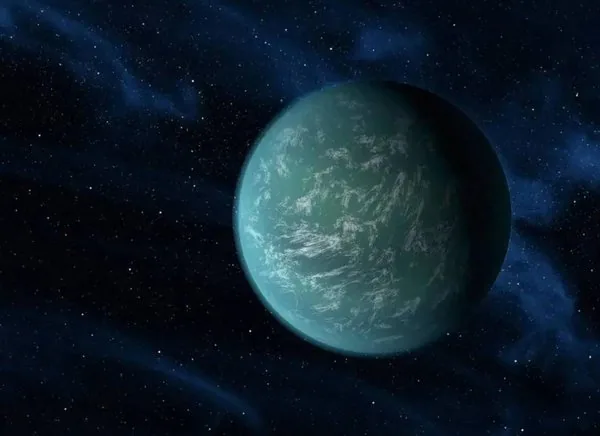
Now Kepler-22b is back in the spotlight as the central element of Apple TV’s hit sci-fi series “Pluribus”, whose season finale aired today. The exoplanet, about 600–640 light years from Earth in the constellation Cygnus, is the first confirmed planet discovered in the habitable zone of a Sun-like star. Although it was first detected on 12 May 2009, NASA officially announced the discovery on 5 December 2011, only after observing three complete transits in front of its host star.
William Borucki, principal investigator of the Kepler mission at NASA’s Ames Research Center and leader of the discovery team, said: “We were lucky in detecting this planet. The first transit was captured just three days after we declared the spacecraft operationally ready. We witnessed the defining third transit over the 2010 holiday season.”
A super-Earth in the golden zone
Kepler-22b orbits a G-type star similar to the Sun but slightly smaller and cooler, with an orbital period of about 290 days. Its radius is about 2.4 times Earth’s, placing it among “super-Earths”. Scientists are still unsure of its composition: it could be rocky like Earth, entirely covered by ocean, or like a smaller version of Neptune with a dense gaseous envelope. Models suggest that if Kepler-22b has an Earth-like atmosphere, its surface temperature could be around 22°C. Different atmospheric compositions, however, could create very different conditions — from Venus-like heat to Mars-like cold.
From scientific discovery to popular culture
The exoplanet has captured the public imagination through “Pluribus”, created by Breaking Bad writer Vince Gilligan and starring Rhea Seehorn. The series, which began on 7 November 2025 and ended its first season today, portrays Kepler-22b as an ocean world that sends a signal that changes humanity’s course. It broke Apple TV’s record for the biggest global launch of a drama series and has already been renewed for a second season.
In episode eight, characters look at the star Kepler-22 through a telescope while discussing the planet’s true nature. One says: “We have no idea what they call it. Sometimes we close our eyes and try to picture it.”
Despite this fictional portrayal, no real signal has been detected from the Kepler-22b system. The planet remains about 640 light years from Earth — a distance that would take about 11 million years to cover even at Voyager 1’s current speed.