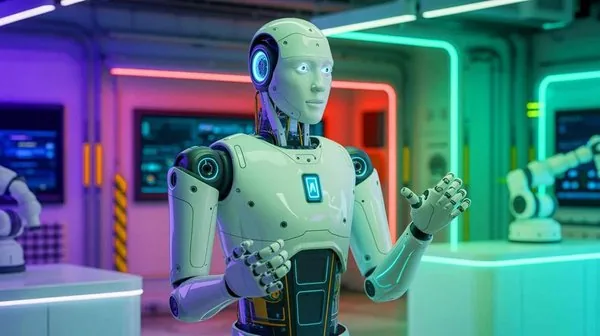
Berlin – Humanoid robots, which until recently existed only in science fiction, are now becoming a reality approaching everyday life.
Supporters see them as a solution to labour shortages, while critics warn of security, privacy and ethical risks. Analysts predict that by 2035 millions of humanoid robots could enter homes and workplaces. Morgan Stanley even estimates that by 2050 their number could reach one billion — roughly one robot for every 10 people.
The global humanoid robot market (including manufacturing and related services) could exceed USD 5 trillion. Advocates say robots can fill labour gaps, help care for the elderly and take over repetitive household chores. Sceptics warn that rushed deployment raises unresolved issues around security, privacy and the replacement of humans.
David Reger, founder and CEO of German company Neura Robotics, believes humanoid robots will soon be essential for ageing societies, offering reliable solutions in manufacturing, healthcare and the home. “These robots do the things people don’t want to do — from taking out the rubbish to loading the dishwasher. The result is that people will have more time for creative pursuits such as painting, music or writing,” he says. Since 2019 his company has introduced the home assistant MiPA and the 4NE1 prototype, a robot with 360-degree perception and human-like movement designed for factories and homes.
Can humanoid robots be trusted?
Humanoid robots are designed to learn, adapt and even act independently, which has sparked a debate on trust among experts and the public.
Cinematic images from “The Terminator” to “Ex Machina” have fed public fears of robots rising up against humans. Although scientists stress that such scenarios remain fiction, ethicists say the growing use of autonomous robots in sensitive roles such as security, childcare and elder care raises real questions of accountability. If a robot malfunctions while caring for an elderly patient, who is responsible? Who is liable for an error in the workplace? Legal frameworks will have to develop alongside the industry.
Reger, however, argues: “Humans have souls, so they can be good or bad. They have goals such as wealth or power. Robots and AI have no such thing… I believe there is no such thing as a bad robot.” Critics counter that even without intent, a weak or hacked system can cause harm.
Different directions in the industry
The global robotics market has expanded rapidly in recent years. While companies such as Tesla and Boston Dynamics focus on power, mechanical durability and mobility, US company Realbotix focuses on human-centred design, building robots with realistic faces and conversational AI. CEO Andrew Kiguel says: “We never imagine that a robot that looks like a vacuum cleaner can care for a patient in hospital or a pupil at school. Our robots are designed for emotional and intellectual tasks, not just physical ones.” The company’s humanoid assistant Aria can recognise faces, interpret emotions and respond in several languages, and serves customers in shopping centres and hotels.