
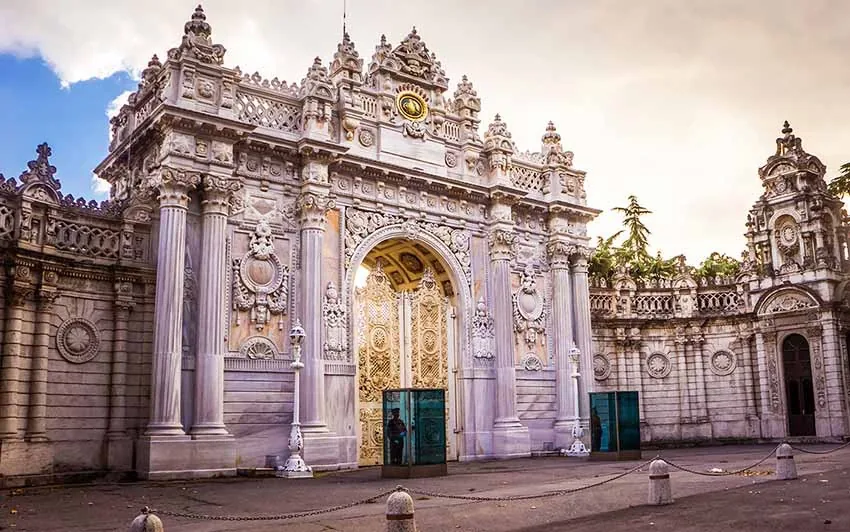
Dolmabahçe Palace — Beşiktaş
A complete visitor’s guide to the magnificent legacy of the Ottoman Empire
Dolmabahçe Palace, one of Istanbul’s most luxurious and imposing historic buildings, stands on the shore of the Bosphorus in the Beşiktaş district. It is not only one of the most important symbols of power and luxury in the late Ottoman Empire, but also a unique blend of European architecture and Eastern art.
History and Construction
The palace was built between 1843 and 1856 on the orders of Sultan Abdülmecid I. Until then Topkapı Palace had been the official residence of the Ottoman sultans, but Abdülmecid decided to build a more modern, European-style residence. The palace was designed by two Ottoman Armenian architects, Garabet Balyan and Nigoğayos Balyan.
With more than 45,000 square metres of floor space on a 110,000-square-metre site, Dolmabahçe was home to six Ottoman sultans for nearly 70 years and served as the empire’s last administrative centre.
Architecture and Interior Decoration
The palace has 285 rooms, 44 grand halls, 68 toilets and 6 Turkish baths. Its architecture blends European Baroque, Rococo and Neoclassical styles with traditional Ottoman elements, giving the building a magnificent appearance.
More than 14 tonnes of pure gold leaf were used in the interior decoration, and 131 handwoven silk carpets from the famous Hereke workshops cover the floors of the halls.
The Giant Chandelier and Precious Gifts
One of the palace’s highlights is the enormous Bohemian crystal chandelier given to the Ottoman sultan by Queen Victoria. With 750 lamps and a weight of about 4 tonnes, it is one of the largest chandeliers in the world.
Historical Significance
One of the palace’s most visited rooms is that of Mustafa Kemal Atatürk, founder of the Republic of Türkiye. Atatürk died in this simple room on 10 November 1938. Since then the room’s clock has been stopped at 9:05, the exact time of his death, and every year at that moment people across Türkiye observe a silence in his memory.
Location
Address: Dolmabahçe Caddesi, Beşiktaş district, Istanbul
Getting there: T1 tram / F1 funicular – Kabataş station, or by bus
Visiting hours: 9:00–16:00 (daily, closed on Mondays)