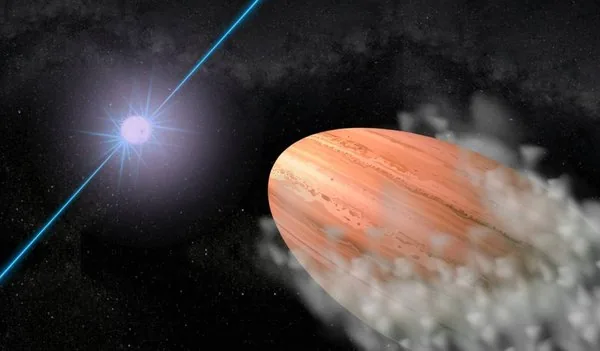
NASA’s James Webb Space Telescope has discovered the exoplanet PSR J2322-2650b — a Jupiter-mass planet with an unusual helium and carbon atmosphere that orbits a pulsar at a very close distance of about 1.6 million kilometres. The pulsar’s intense gravitational pull has stretched the planet into an elongated, lemon-like shape.
The planet’s surprising features
- An unprecedented atmospheric composition with molecular carbon (C2 and C3) instead of common compounds such as water or methane
- Soot-like clouds in the atmosphere
- The possibility of diamonds forming deep inside the planet
- The origin of this unusual composition remains unclear to scientists
Another historic Webb discovery
Webb also detected the supernova GRB 250314A, an explosion that occurred when the universe was only 730 million years old. It is recorded as the oldest supernova observed so far and provides a direct look at massive stars during the universe’s era of reionisation.
These discoveries push the boundaries of astrophysics and offer a fresh picture of planetary diversity and the early history of the cosmos.